
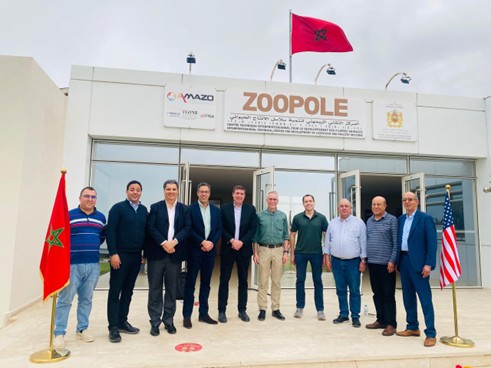
Last week, U.S. Grains & BioProducts Council (USGBC) staff traveled to Casablanca, Morocco, to follow up on livestock industry growth resulting from the Council’s development of a regional training center for poultry production in recent years.
The training center is a collaboration between the Council and the Moroccan Poultry Association (FISA) dating back more than nine years, focused on training thousands of West African poultry professionals in improved production practices and value chain development.
“Engaging directly with key Moroccan agribusiness stakeholders – particularly to assess the outcomes of our training programs and evaluate their replicability in other markets – was essential to cementing the Council’s standing as a trusted partner within Morocco’s livestock industry,” said Mohamed Salah Bouthour, USGBC deputy regional director for Africa.
“The Council’s on-the-ground presence, coupled with its technical assistance, not only stimulates end-user demand for feed grains but also strengthens familiarity with and preference for U.S. products, thereby expanding market share for U.S. corn and its co-products.”
Bouthour was joined by USGBC Senior Director for Global Strategies and Trade Kurt Shultz, USGBC Manager of Global Strategies and Trade Mark Sevier and USGBC Consultant for Morocco Abdellah Ait-Boulahsen.
The team also held a meeting with U.S. Department of Agriculture Foreign Agricultural Service (USDA FAS) staff based in the country to learn about economic and political factors impacting agriculture and trade with Morocco and how Morocco can play a role in expanding U.S. trade to Sub-Saharan Africa.
“The Council deeply values its long-standing relationships in Morocco – partnerships that have continued to grow and evolve meaningfully over time,” Shultz said.
“As the feed and poultry industry across West Africa expands, Morocco stands out as an exceptional platform for showcasing the broad benefits of U.S.-Africa trade and demonstrating how such collaboration can be a truly mutual endeavor – one with the power to improve lives and drive sustainable prosperity through trade.”
Learn more about the Council’s work in Morocco on the here.