
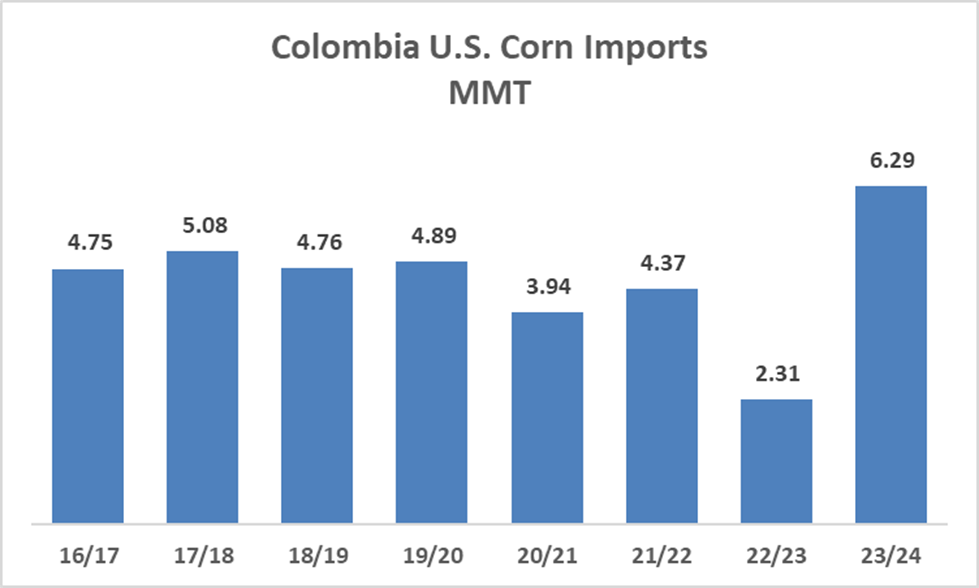
Colombia is the third-largest export market for U.S. corn, benefiting from duty-free access under the U.S.–Colombia Trade Promotion Agreement (CTPA). In late 2023, growing political pressure within President Petro’s administration to reduce import dependence and strengthen domestic production brought renewed scrutiny to agricultural imports, particularly U.S. corn.
Echoing the arguments previously used to impose countervailing duties on U.S. ethanol, Colombian authorities raised concerns that U.S. farm subsidies were distorting the market and harming local producers. When Colombia’s Ministry of Trade signaled the possibility of a Countervailing Duty (CVD) case against U.S. corn imports, the U.S. Grains Council moved to protect this critical export market.
Working closely with U.S. and Colombian government officials, as well as key Colombian industry associations, importers, and end-users, the Council provided timely market intelligence, coordinated a unified defense, and advocated powerfully to maintain duty-free access under the U.S.-Colombia Trade Promotion Agreement. These efforts were carried out in close collaboration with the Foreign Agricultural Service (FAS) in Bogotá, whose support was instrumental in reinforcing U.S. policy messaging and maintaining open lines of communication with Colombian authorities throughout the process.
The Council also reinforced trust through targeted technical support, including a Corn Quality Report (CQR) session in February 2024 organized in partnership with the Colombian Business Chamber (ANDI), where Colombian regulators from the Colombian Institute of Agriculture and Livestock (ICA), the National Institute for Food and Drug Surveillance (INVIMA) and the Ministry of Agriculture received scientific data and clarified questions about U.S. corn grading and safety standards.
In July 2024, the Council and FAS Colombia led a trade facilitation mission to New Orleans, where Colombian officials observed U.S. grain inspection procedures conducted by USDA, the Federal Grain Inspection Service (FGIS), and the Animal and Plant Health Inspection Service (APHIS). These hands-on experiences directly addressed quality-related concerns raised by domestic producer groups and provided Colombian authorities with a clearer understanding of the U.S. system.
In parallel, leaders from Colombia’s feed and livestock associations traveled to Washington, D.C., in May 2024 to meet with U.S. government and congressional representatives. Their direct advocacy efforts, supported by the Council, added pressure to maintain open trade under the U.S.–Colombia Trade Promotion Agreement and underscored the consequences of disrupting this strategic supply chain.
These combined efforts helped to prevent the launch of a CVD case. While the issue has not advanced, it remains active on the political agenda. For that reason, sustaining strong relationships with industry allies and government authorities continues to be essential to protect long-term access to the market.
By investing $105,000 of MAP and RAPP funds, the Council secured continued market access for U.S. corn into Colombia, worth $1.4 billion annually and prevented new trade barriers from undermining this vital export market. This translates to a return on investment of $13,333 for every $1 of MAP and RAPP invested.
While Colombia’s domestic pressures persist, the Council remains committed to ensuring U.S. corn stays competitive for years to come.