
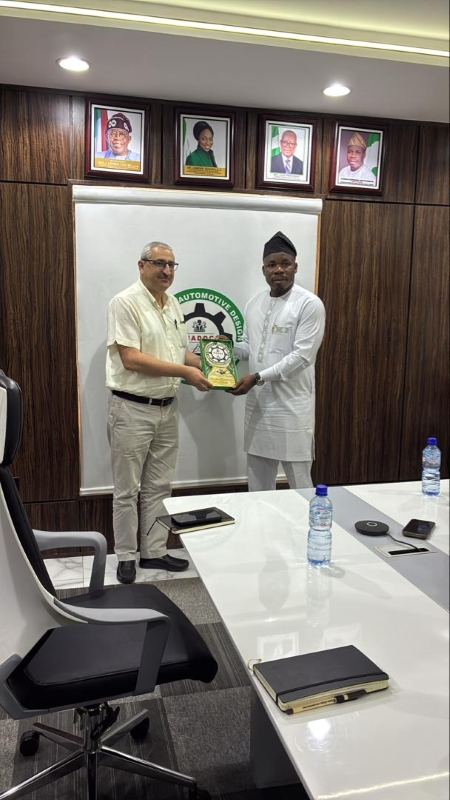
Staff based in the U.S. Grains & BioProducts Council’s (USGBC’s) regional office for Europe, the Middle East and Africa (EMEA) recently traveled to Nigeria to accelerate its E10 pilot preparation by promoting the benefits of transitioning to E10 blending, especially with new leaders of key stakeholders in the public and private sectors.
USGBC EMEA Regional Director Ramy H. Taieb was joined by USGBC Ethanol Technical Consultant and Advisor Rowena Torres Ordonez and USGBC EMEA Regional Ethanol Consultant Gbenga Apampa.
“These stakeholder engagements were timely and critical, as recent policy changes position Dangote Refinery, the world’s largest single-train refinery, as Nigeria’s main domestic supplier,” Taieb said.
“Significantly, the refinery is already equipped with ethanol storage, blending facilities and dedicated pipelines, has previously engaged with the Council in technical sessions and has been linked to U.S. ethanol suppliers.”
The Council’s delegation met with the Nigerian Midstream and Downstream Petroleum Regulatory Authority (NMPDRA), the department spearheading E10 biofuel implementation in the country, to offer further technical support in the ongoing preparations for an E10 pilot project.
In addition to visits and meetings with local importers of U.S. ethanol, the Council’s team toured two fuel stations in Abuja earmarked to participate in the E10 pilot, held top meetings with the Standards Organization of Nigeria (SON), the National Automotive Design and Development Council (NADDC), the U.S. Agricultural Counselor and staff of the U.S. Department of Agriculture’s Foreign Agricultural Service (USDA’s FAS) based in Nigeria.
“An E10 blending mandate implemented on a national and commercially scaled level would likely incentivize investment in Nigeria’s domestic ethanol industry and create an estimated 400 million gallons of ethanol demand for fuel blending, of which the majority will be imported initially, potentially doubling U.S. agricultural trade with Nigeria,” Taieb said.
“The Council will continue collaborating with its partners at the office of the U.S. Trade Representative and the U.S. Department of Agriculture to create a pathway for mutually beneficial trade for U.S. ethanol producers in this major market.”
Learn more about the Council’s work in Nigeria on the Council’s website.