
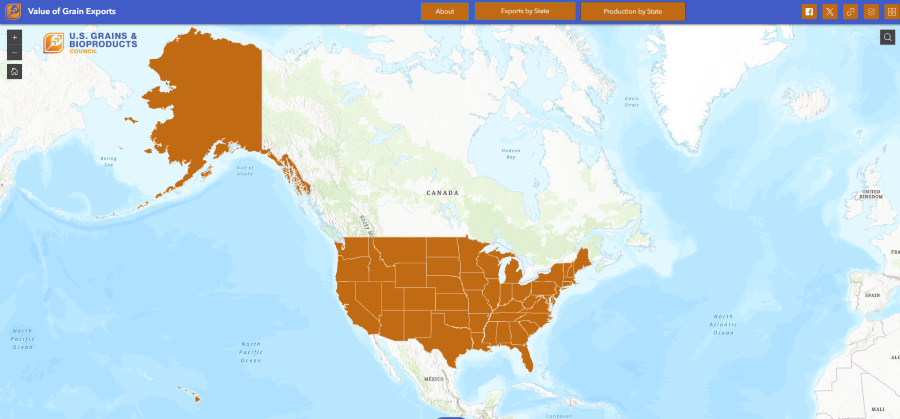
The U.S. Grains & BioProducts Council (USGBC) has updated its Value of Grains Exports study with the latest available information about the financial benefits of agricultural exports to communities across the country.
The study, jointly commissioned with the National Corn Growers Association (NCGA), examines the economic contributions provided by exports of malt barley, other barley, corn, corn gluten feed and meal, distiller’s dried grains with solubles (DDGS), ethanol, sorghum and the corn equivalent of beef, pork and poultry on the U.S. economy.
The study specifically highlights the economic contributions provided by each U.S. state and individually analyzes them with the goal of quantifying the degree to which state economies rely upon and benefit from grain exports.
Results from the analysis show the $27.57 billion in grain and grain products exported indirectly supported a total economic output of $79.31 billion in 2024. In other words, access to international export markets for U.S. grains supported nearly an additional $51.74 billion in business sales during 2024.
Moreover, the export of grain products supported U.S. GDP by $32.589 billion over what would have occurred without such exports. Finally, the number of jobs linked directly or indirectly to grain exports totaled roughly 309,129.
Further analysis shows that for every dollar of grain product exports generated, through indirect and induced business activities, $2.88 in business sales are supported across the United States.
“The U.S. agricultural industry has always been a key cog in the nation’s economy, and this resource precisely identifies how states benefit from strong U.S. trade relationships in markets around the world,” said Bryan Jernigan, USGBC director of communications.
The online interactive platform allows users to break down each state in the U.S. based on total value of exports and production, with downloadable PDF infographics available as well.
Explore the updated Value of Grain Exports study on the Council’s website.