
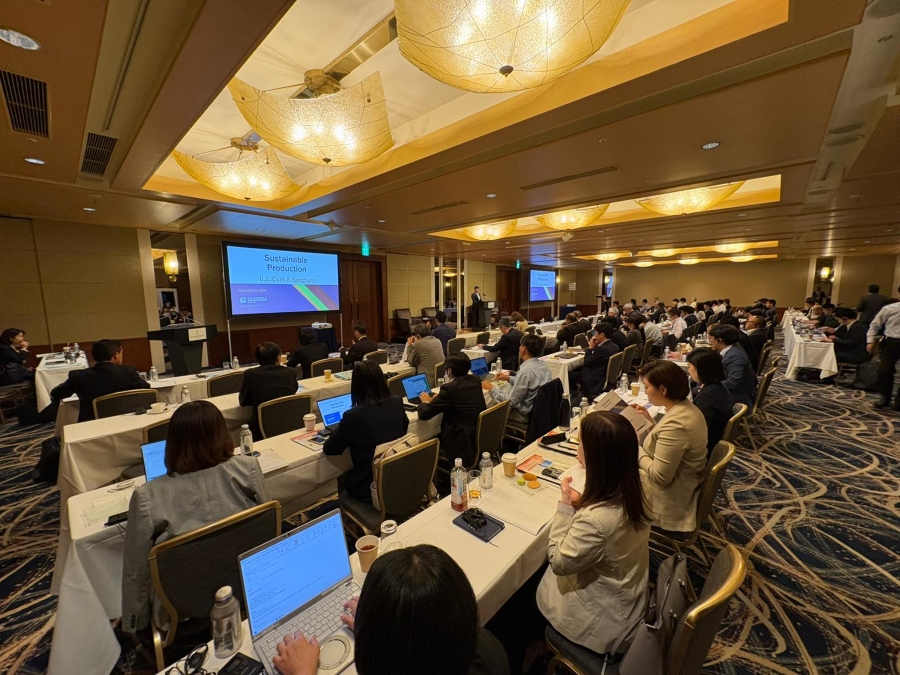
Last week, the U.S. Grains & BioProducts Council (USGBC) hosted the U.S. Feed Grains and Sustainability Conference and roughly 100 Japanese buyers and end users in Tokyo, Japan, sharing U.S. feed grains’ sustainable production practices and tools available to help customers import U.S. agricultural goods.
Past USGBC Chairwoman and New Mexico sorghum farmer Verity Ulibarri and USGBC Director of Global Sustainability Carlos Suárez traveled to Japan for the event to share their respective expertise in responsible land stewardship and the Council’s resources for importers.
“The Council has developed tools, including the Corn Sustainability Assurance Protocol (CSAP) and Sorghum Assurances Protocol (SAP), to enhance U.S. agriculture’s competitiveness in mature markets by highlighting the practices U.S. farmers are already employing,” Suárez said.
Before the event, USGBC Director in Japan Tommy Hamamoto appeared on a panel discussion at BioInnovasia 2026 to demonstrate U.S. ethanol’s ability to meet Asia’s sustainable aviation fuel (SAF) and low carbon fuel demand.
Later that day, the Council’s team met with representatives from the Ministry of Agriculture, Forestry and Fisheries (MAFF) to align on governmental and consumer interest in sustainable agricultural development.
The conference kicked off with an address from U.S. Embassy Agricultural Attaché Craig Elliott and featured presentations about U.S. farm sustainability management practices, basics of the CSAP and expanding developments like the SAP.
Following the conference, the Council’s team participated in two industry roundtable events that furthered discussions about the value of U.S. feed grains in the Japanese market, particularly regarding sustainability metrics and applications in aquaculture feed.
“Bringing expert speakers like Verity and Carlos create strong engagements with Japanese customers about U.S. sustainability efforts and help them visualize the Council’s work to defend U.S. market share in Japan,” Hamamoto said.
Learn more about the Council’s work in Japan on the organization’s website.